Please keep in mind that I only have experience in software development, finance, and manufacturing, and lack experience in other sectors, so this may represent a limited perspective.

1. Background of the Discussion on the Special Semiconductor Act (Exemption from the 52-Hour Workweek)
"Long Hours of Deep Focus Are Essential for Global Technological Competitiveness"
- Business / Conservative Perspective: They argue that because the semiconductor industry must maintain a 'super-gap' globally, in the research and development (R&D) stage, long hours of deep focusare inevitable.
- Presenting the rationale that "foreign competitors engage in a speed battle through all-night researchor 'task force'-style project execution whenever necessary," they claim that Korea should also lift the 52-hour cap, at least for R&D personnel, and operate flexibly .
- Their logic is that "especially in sectors like semiconductors, which require repeated microfabrication competition, production line optimization, and design testing, there are frequent times when an intensive push is needed over a single week."
"Extending Working Hours Does Not Yield Creative Innovation"
- Labor Sector and Some Experts: On the other hand, they point out that "creativity and innovation come not from 'time,' but from work efficiency, the quality of focus, and organizational culture."
- An expert formerly with Samsung Electronics' semiconductor division (Director Park Jun-young interview) has already emphasized, "Long working hours only accelerate burnout and talent drain, and task distribution and efficiency improvementsare what truly matter."
- Citing cases such as SK Hynix, which has applied for special overtime far less than Samsung Electronics yet has recently overtaken Samsung Electronics in certain technological areas, they also offer the counterargument that "working hours and semiconductor competitiveness have little direct correlation."
2. The Old Debate: "Diligence vs. Efficient and Creative Work"
Concerns That "Koreans No Longer Work as Hard as in the Past"
- Among some venture capitalists (VCs) and founders, a "slacking off" controversyis often raised, with remarks like "these days, startup employees don't even properly put in 40 hours a week, let alone 52 hours" and "hardly any office lights are on on weekday evenings."
- Their argument is that "because startups begin on an uneven playing field, working efficiently is a given, and they must also invest an absolute amount of time." In other words, the logic is that for a small organization to achieve results in a short period, long hours and high-intensity workare inevitable.
"Long Hours Are Not the Answer. A Culture of Efficiency and Focus Is Key"
- On the other side, the equation "long working hours = productivity" is seen as an outdated paradigm.
- Numerous research studies show that "long working hours actually hinder creative ideas and high concentration, causing burnout and lowering overall organizational performance."
- Critics also point out, "Even for a startup, fundamentally, performance-oriented smart workmust take root. Simply sitting for a long time does not increase the probability of success."
3. Diverse Perspectives Surrounding "Is Easing the 52-Hour Rule Really the Answer?"
- Summary of Arguments from Business and Government
- In cutting-edge R&D fieldssuch as semiconductors, batteries, and bio, an intensive push during specific periods is crucial, so let us apply an exemption to the 52-hour cap.
- As long as the individual worker's "consent" or "compensation" conditions are met, flexible long working hoursneeds to be permitted.
- Institutionalizing ways to concentrate work when necessary and guaranteeing vacations and paid leave later (flexible work arrangements) is essential for boosting corporate competitiveness.
- Backlash from labor unions and field engineers
- "In reality, 'employee consent' can easily be compromised by performance review pressures.Ultimately, there is a high chance companies will attempt to bring back the old practice of 'coerced overtime.'"
- Given that there are already company cases that achieved great results while adhering to the 52-hour workweek (even with almost no special overtime extensions), organizational culture and strategy, rather than hours,determine competitiveness.
- In the short term, more products and ideas might emerge, but in the long run, talent drainand burnoutare very likely to stifle innovation instead.
- A moderate perspective: Institutional flexibility itself is needed
- While the working hour cap's fundamental intent (reforming long working hour practices, protecting workers' right to health)must be upheld, industry- and job-specific characteristicswarrant a certain degree of flexibility provisions.
- For instance, for research and development fields,under the strict condition of mutual agreement between labor and management, an annual cap on total hourscould be retained while permitting intensive work during specific project periods as a supplementary measure.
- However, there is also a view that long hours and low-wage laborshould not be effectively forced by exploiting institutional loopholes, and thus supervision and penaltiesmust be strengthened.
4. Key points easily missed in the actual workplace
- Changes in organizational culture and leadership are more critical
- For example, during Samsung Electronics' prime ("Work Smart" era), along with efforts to "reduce" working hours, streamlining work and breaking down inter-organizational silos were innovations pursued in tandem, which is noteworthy.
- Conversely, when closely analyzing why recent sluggish performance coincided with a return to a "Work Hard" stance, some argue that rather than just working hours, a regression in leadership, evaluation methods, and organizational culture might have exerted a greater impact.
- The pitfall of the formula 'Long Hours = Deep Focus'
- Most people who have worked in R&D fields agree that "sitting at a desk for 14 hours a day does not mean you are fully focused and working the whole time."
- Even for areas requiring 24-hour operation, such as semiconductor testing processes, three shiftscan be run, and critics point out that the claim that "one person must stay on for 16 hours" is hard to justify.
- Startup reality: The challenge of having to spend long hours with high efficiency
- Because early-stage startups lack manpower, capital, and infrastructure, the argument that a certain degree of long-hour passionis necessary also has merit.
- However, if you forget that "simply working long hours does not guarantee innovation," systematic work distributionor deep immersion and creative attempts, it could easily lead to the worst-case scenario of 'just racking up overtime.'
- Moreover, work-life balance and the values of the MZ generationare hard to ignore in this era. For startups facing hiring difficulties, they will need the wisdom to create a working environment where they can grow togetherwith their employees.
5. In conclusion, which direction is desirable?
- Long working hours in themselves do not guarantee innovation.
Whether in R&D or at startups, there are far more cases where success came from "high focus and strong execution" rather than "working long hours." - However, the 52-hour cap is not an absolute sacred cow either.
At times, instead of a weekly basis, flexible operationon a monthly or annual basis may be necessary. Yet, so that this does not morph into "virtually allowing unlimited overtime," the effectiveness of employee consent proceduresand supervisory and sanction mechanismsmust be put in place to back it up. - Is a dynamic where 'the company (organization) forces long hours and individuals avoid it as much as possible' desirable?
Absolutely not. Rather, a mutually beneficial innovation of organizational culturemust come first.- If it's a startup, they should strive to establish reasonable goals, adopt automation and productivity tools, and set up performance-based evaluation systems so that even when an hour is spent, it yields proper results.
- Companies that require large-scale R&D, such as semiconductor firms, should first examine how much they have eliminated wasteful factorsfrom their existing organizational culture, leadership, and R&D processes, rather than just repeating that "exceptions to working hours are an absolute must to keep from falling behind foreign competition."
- Long-term national competitiveness ultimately comes from 'people.'
The logic that a country thrives only when people work hard unconditionally might have worked during the past high-growth era, but the counterargument that today a "system that overworks people" actually eats away at competitiveness is well worth considering. On the other hand, no matter how much efficiency is improved, if the absolute time invested in work is sorely lacking, falling behind in the competition is inevitable.- In other words, finding the right balanceis critical, and this means we need a multi-layered approachthat doesn't view the "52-hour workweek as the absolute good" nor "long working hours as the ultimate solution."
Conclusion
- The Special Semiconductor Act(exempting the R&D workforce from the 52-hour limit) might be one wayto bolster the competitiveness of the semiconductor industry, but many view thinking that "doing only that will revive the Korean semiconductor industry" as an oversimplification.
- There are already cases showing that the slump or boom of Korean semiconductors (Samsung and SK Hynix) depends far more on market shifts, product strategy, and leadership than on working hours, and it is hard to ignore the fact that the majority of those directly involved (the R&D researchers) are opposed.
- Furthermore, regarding the concern that "Koreans work less hard than before," a real breakthrough will only open up when we contemplate how to build an improved organizational culture, refined work methods, and individual motivation structures, rather than responding simply by pushing to increase long working hours.
- Just as extreme solutions like "we can only survive by completely disregarding work-life balance and working 70 to 80 hours" are problematic, "stubbornly clinging only to the 52-hour cap and applying it uniformly without granular flexibility" is also problematic. Therefore, we need reasonable flexibilityand worker protection, organizational innovationmust go hand in hand is the key point, in my opinion.
My stance?
- If the comprehensive wage system is abolished and pay is truly calculated for the hours worked, I support adjusting the 52-hour workweek.
- I disagree with the view that abolishing the 52-hour cap will boost productivity and improve performance.
- The fact that this discussion is being brought up alongside the recent 'Semiconductor Special Act' seems very intentional.
- Then are we going to revise special acts for every single industry, such as display, bio, and software?
- It is right to leave the 52-hour system as a bastion for people's lives.
- Allow people to work more if there is mutual consent, by processing work permit applications retroactively in bulk or simplifying them (currently requiring ministerial approval).
- Taiwan, Japan, China, etc., also observe the 52-hour system... The problem in Korea right now is that exceeding 52 hours is overly regulated. There ought to be other ways, such as paying proper wages.
References
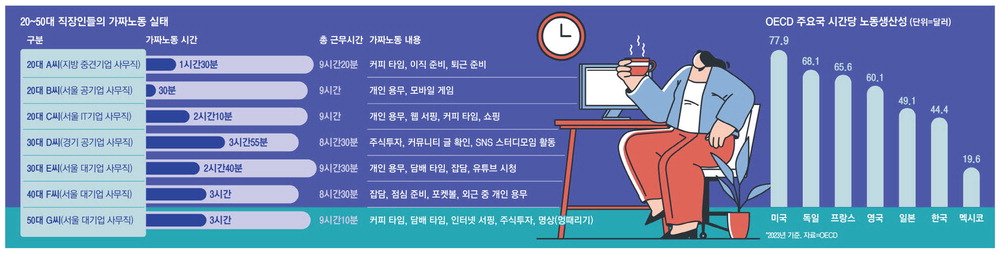
Maeil Business NewspaperSmall talk, web surfing, smoke breaks after coming to work... Assistant Manager Kim and General Manager Park are both 'salary thieves' - Maeil Business NewspaperMajor labor reform: The reality of 'fake work' among South Korean office workers. 27% of working hours wasted on 'slacking off'. Serious regardless of age or job title. Investing in stocks, online shopping. Leaving for lunch as early as 11 AM. Doing personal hobbies during actual lunch hours. The peak hour right before leaving work: handling personal errands, meditating, even preparing to switch jobs.www.mk.co.kr ↗

THE STARTUP BIBLEIf you don't work harderwww.thestartupbible.com ↗

Kyunghyang Shinmun"TSMC's success was achieved by a 'high-salary shock troop'... Lifting the '52-hour' cap in semiconductors will drive talent away"The 'Semiconductor Special Act', which seeks to exempt semiconductor R&D roles from the '52-hour workweek' upper limit to allow for longer working hours, has emerged as a hot potato in politics. The People Power Party and the business community emphasize the need to pass the bill. After Lee Jae-myung, leader of the Democratic Party of Korea, recently stated that exemptions to the 52-hour workweek could be reviewed, pros and cons debates have also erupted within the Democratic Party. The parties directly involved, R...www.khan.co.kr ↗
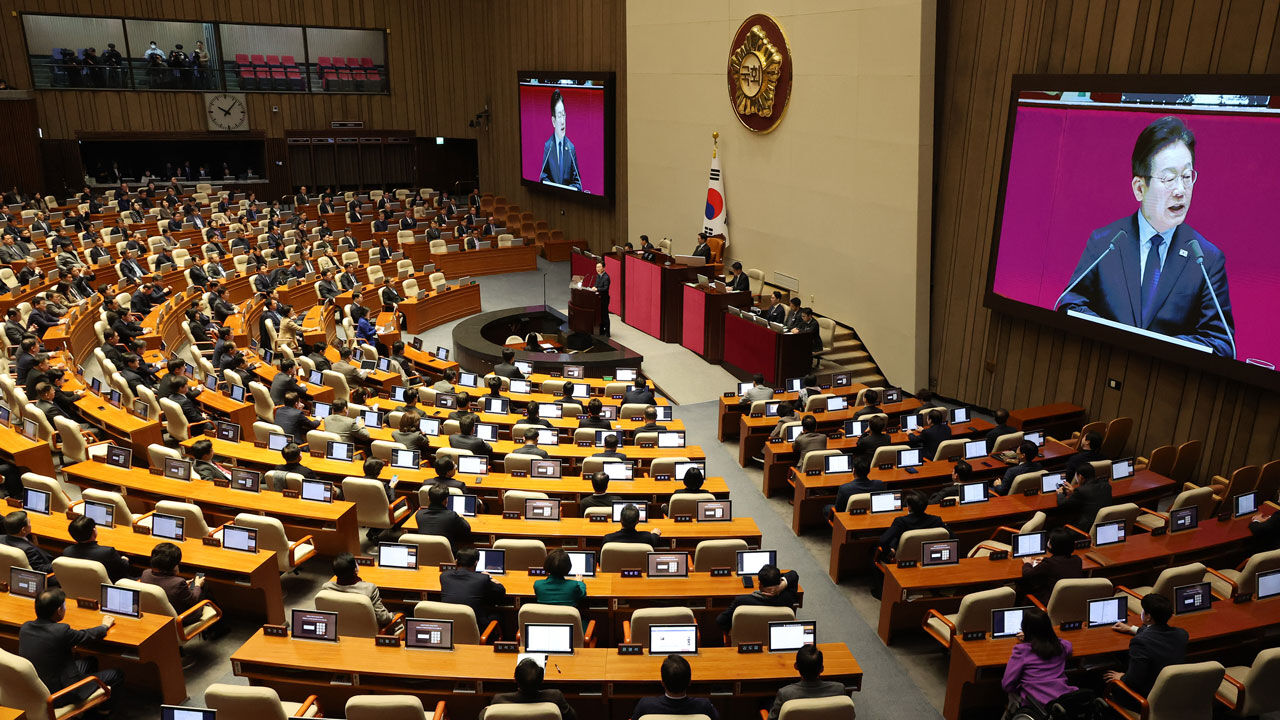
SBS NEWSLee Jae-myung and People Power Party lawmakers engage in an impromptu clash over the 52-hour workweekDuring Democratic Party of Korea leader Lee Jae-myung's speech as representative of the parliamentary negotiating body today, as soon as Lee made remarks regarding working hours, ruling party lawmakers protested from their seats, leading to an 'impromptu clash' between the two sides.news.sbs.co.kr ↗

Naver NewsThe 52-hour dogma that strips away the freedom to work and innovate [Forum]Yang Jun-mo, Professor of Economics at Yonsei University. The National Assembly is discussing the Semiconductor Special Act to protect the semiconductor industry, where nations compete with their very survival at stake. The ruling party intends to include a clause in the special act that exempts working hour regulations, while the opposition party calls it a sensitive issue and...n.news.naver.com ↗
Korean original ↗EOF ■
Leave a thought.
No account needed. All comments appear as “Anonymous” immediately. Korean and English articles share this thread.