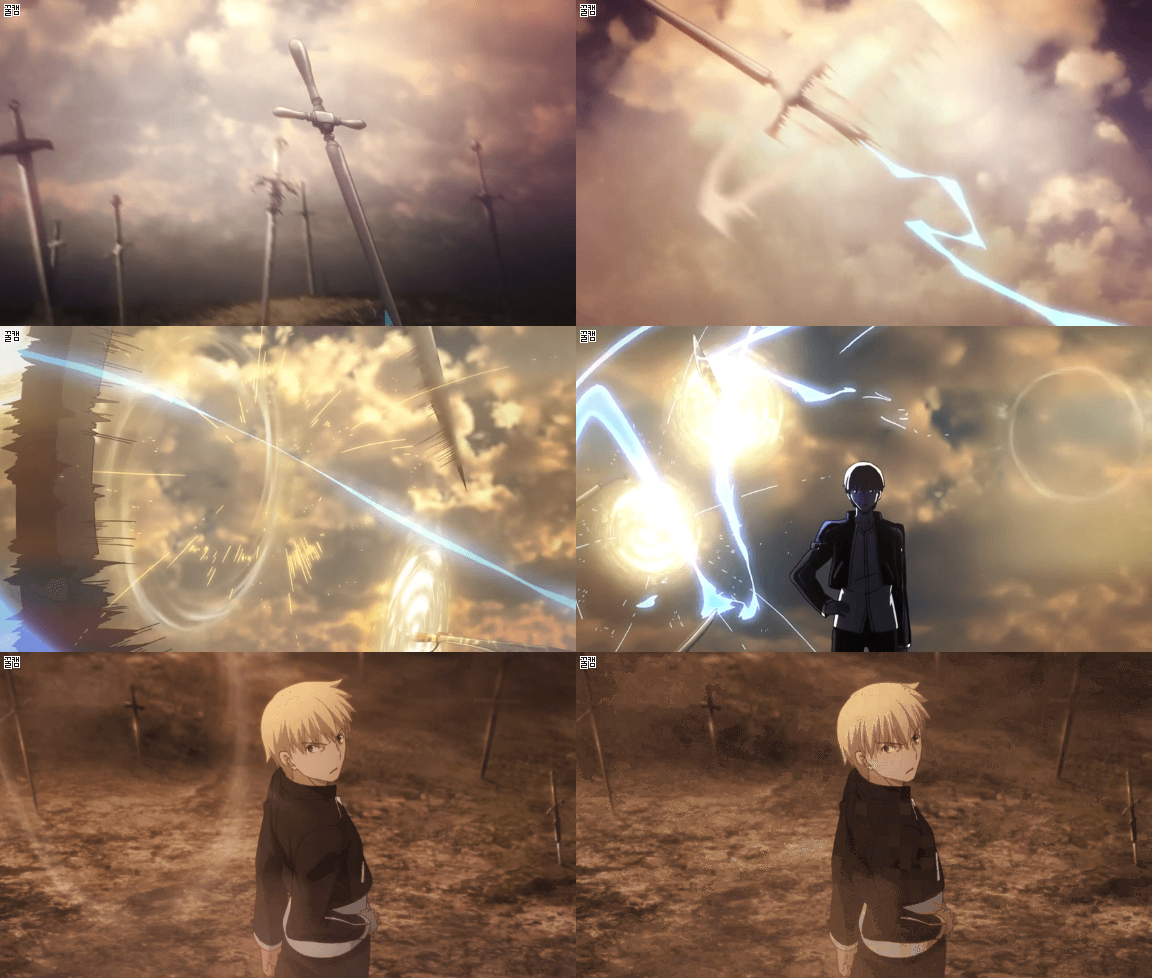

The AT Field in <Evangelion>, Domain Expansion in <Jujutsu Kaisen>, and Reality Marbles in the <Type-Moon Series>. Anyone encountering these for the first time might simply brush them off as "cool fantasy tropes." But when you chew on it for a moment, you realize that each one represents an absolute barrier meant to protect "one's own world (the ego)." In <Evangelion>, the AT Field symbolizes the "wall around the heart," and Domain Expansions and Reality Marbles similarly manifest a user's personal convictions and values into an extreme space. Thus, these devices serve as metaphors for situations where empathy and communication are difficult—in other words, "fragmentation." And this metaphor isn't just a story found in anime or games. We witness deep "fragmentation" in our daily digital environments and in politics and society, where everyone fiercely defends their own barrier.

When I first watched Evangelion as a child, I was deeply shocked. Characters brimming with individuality, the direction, and content that only reveals deeper layers the more you look into it... As it reaches the ending, it makes you ponder understanding, love, and integration, and it even goes further to make you think about totalitarianism and individualism. In the end, Evangelion simply melts people into one under the grandiose name of the "Human Instrumentality Project." Although someone wrecks havoc halfway through, that famous scene resembling orange juice that so many people have seen is precisely that.

<Dragon Ball>, the root of the genre, along with what we commonly call the "Big Three"—<One Piece>, <Bleach>, and <Naruto>—followed the classic shonen narrative path where a "chosen one" awakens to their calling and power, tirelessly striving toward a corresponding goal or the eradication of evil, inspiring dreams and stirring the hearts of many. Fast-forward several years, and when you look at recent trending works like <One-Punch Man>, <Demon Slayer: Kimetsu no Yaiba>, <Chainsaw Man>, and <Jujutsu Kaisen>, the training scenes are extremely brief or skipped over quickly. In a way, those parts can be tedious, and ultimately people want to see overwhelmingly powerful beings clash or witness intense conflict, so naturally such stories have garnered interest.
What actually intrigued me is that recent popular works feature battles where opponents are dragged into one's own space (philosophy/ego/conviction). This is reminiscent of the Reality Marbles that appeared in the Type-Moon series back when it was considered niche. It's a somewhat different approach from the old trope of leaping into the opponent's space to assimilate or establish oneself.
Confirming the Era of Fragmentation
It is by no means an exaggeration to feel that such formidable barriers of the heart have cast their shadow over the real world as well. Everywhere you look, there is a trend of refusing to listen to opposing views and instantly dismissing differences. With just a few clicks, delivering only thoughts similar to our own, YouTube and social media algorithms become a sort of "real-world AT Field,"blocking the infiltration of different information or perspectives. Just like trapping an enemy within a Domain Expansion and overwhelming them with relentless logic or emotion, it becomes easy to hole up in one's own worldview and dismiss the other person as someone who "doesn't need to be understood." Because of this digital environment, points of contact for dialogue diminish, and as fragmentation deepens, we lock ourselves inside an isolated "barrier," just like the anime symbol.

Personal Life and Social Risks
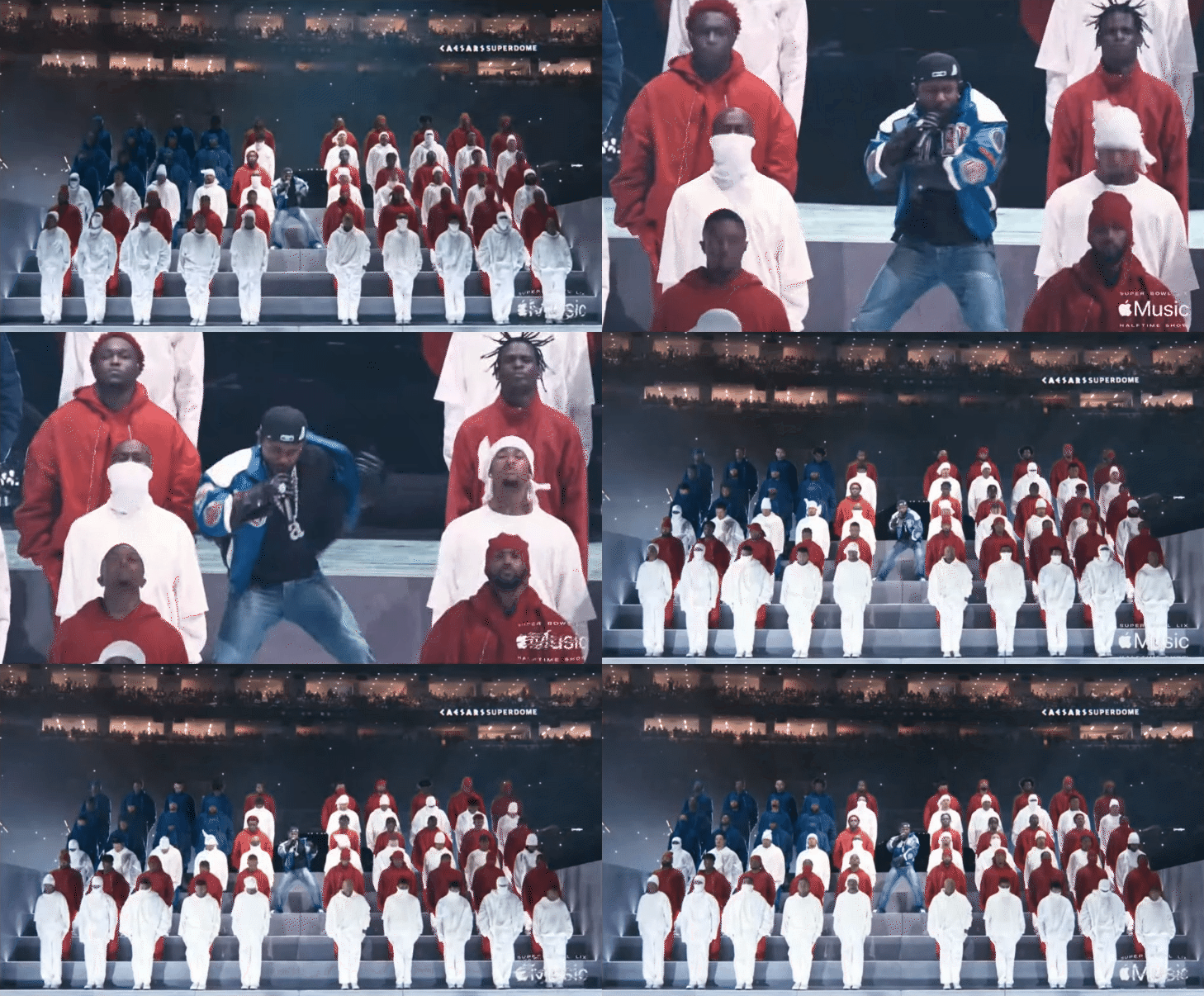
Living behind a barrier of the heart or a Reality Marble might seem comfortable at first glance. There is less risk of getting hurt, and you can live soaked in the certainty that your ideas are always right. However, as those walls grow taller, the trust maintained by the community rapidly vanishes. As the fear that "the other side will attack" amplifies, even the minimal sense of security shared between people shatters. The social and political messages conveyed during recent Super Bowl performances, or the ideological clashes taking place in the comment sections of Korean YouTube, clearly demonstrate that this division has already become normalized. Dichotomous conflict tears fissures across the public sphere, shaking the foundations of both individuals and society.
The Necessity of Strong Public Authority and the Need for Caution
At this point, voices naturally arise asking, "Shouldn't the law and institutions step in?" Acts that deliberately throw society into chaos through fake news or malicious disinformation must be strictly punished. Just as Angels invade and threaten the world in Evangelion, unverified conspiracy theories and demagoguery erode the foundations of democracy in reality. To rein this in, the state's public authority needs to be exercised firmly. However, forcibly attempting to shatter Reality Marbles or Domain Expansions carries the lurking danger of infringing on freedom of expression. If public authority leans toward a particular ideology or loses transparency, it will merely trigger another conflict, deepening the chasm of division. Let me be clear: strengthening public authority does not mean reviving the riot squads or tactical police units of the past. It means social respect and trust. If calling the police derogatory slurs, smearing prosecutors, and doxxing judges continue to be repeated, who would ever want to sit in those positions? If top talent avoids critical roles, who will be left to fill them?
Individual Attitudes Moving Beyond Fake News
No matter the institution, its power to tear down an individual's "wall around the heart" is bound to be limited. The real problem lies in the fact that we are already consuming only biased information inside our own barriers, without even making an effort to understand others. That is why, prior to formal procedures or legal penalties, each person needs at least an attitude of "listening" and "dialogue." Even if another person's thoughts seem absurd or offensive by your standards, the habit of asking, "Why did they reach that conclusion?" is crucial. This doesn't mean blindly accepting it, but rather attempting to understand that worldview first. Only then can we undergo a process of refutation and verification instead of hatred and exclusion, and reborn into a community with a functioning self-cleansing capacity, rather than one run rampant by fake news as it is now. Of course, this process requires immense effort. It will also take a lot of time.

We usually believe and accept things that have been socially agreed upon. For example, if a doctor tells us where it hurts, we accept it; if something is published in the newspaper, we take it that such an event occurred. When a professor speaks about their field, we listen knowing they are an expert, and when a judge delivers a final third-trial verdict, we must accept it. But this is only possible in a society abundant in trust capital.
When trust capital collapses, we begin to harbor suspicions like this: "Isn't that doctor overprescribing me right now?", "Isn't that article actually biased and fabricated?", "Is that professor really an expert?", "I heard where that judge is from; aren't they swayed by regional prejudice?" and so forth. This kind of approach is ultimately the beginning of shaking the entire society, rule of law and all. This is why I always say we must guard against falsehoods and demagoguery. If someone around you does this, you must stop them or keep your distance.
What About Society, Then?
Looking at today's society hurtling toward division, you might feel inclined to step back and erect your own barrier even more solidly. That seems to bring less conflict and feels more comfortable. But on a national scale, a world split apart on all sides with only reinforced Reality Marbles will invite greater anxiety and chaos. Advanced nations like the US and Japan have frameworks in place to negotiate across party lines or maintain policy continuity, at least on core national issues. Even if they are rival parties on ordinary days, they become one team for the national interest. In South Korea's case, the judiciary and executive branches often clash sharply entangled with political interests, and whenever public opinion fractures along ideological or partisan lines, conflicts severe enough to shake the social system break out frequently. If we repeat such situations, the entire nation will ultimately fall into disarray.
What We Must Not Forget
Just as the AT Field or a Reality Marble is a cool concept, strongly defending one's convictions can seem appealing on one hand. But Evangelion, Jujutsu Kaisen, and the Fate series have all consistently asked the same thing: "Can we reach a real answer simply by unconditionally excluding or destroying others who enter this domain?"That is the question being asked. While division can sometimes generate energy for progress, we must not forget that fragmentation reaching an extreme, as it is now, only brings destruction to many things.
In manga and anime, the solution to this problem is simple: tear through the opponent's AT Field, kill the caster who deployed the Reality Marble, or overpower them with a stronger Domain Expansion. Then the opponent meets death or suffers a fatal blow. It's a cool and entertaining trope because fictional works have relatively clear lines of good and evil and treat death lightly, but these days I fear it is becoming reality.
Because it's a critical moment...
For instance, whether the current presidential impeachment is upheld or dismissed, will the opposing camp just sit quietly? Whatever decision is made, whether riots or civil unrest recur, we will once again see national opinion severely divided, repeating the pattern of pulling each other down. And right now is one of the few inside-track overtaking opportunities where the entire world is competing fiercely.
We need to identify key areas where we must cooperate across party lines and learn the attitude of setting aside differences of opinion in those realms. By preserving transparency so that strong public authority remains unbiased, and by repeatedly listening—even just a little—to the worldviews of others on an individual level, division can be minimized. Ultimately, doesn't the power to overcome division lie not in curling tightly inward like an AT Field or a Domain Expansion, but in opening the wall and stepping out to meet the other person? That path is by no means easy, but it may be the only way we can live together.